
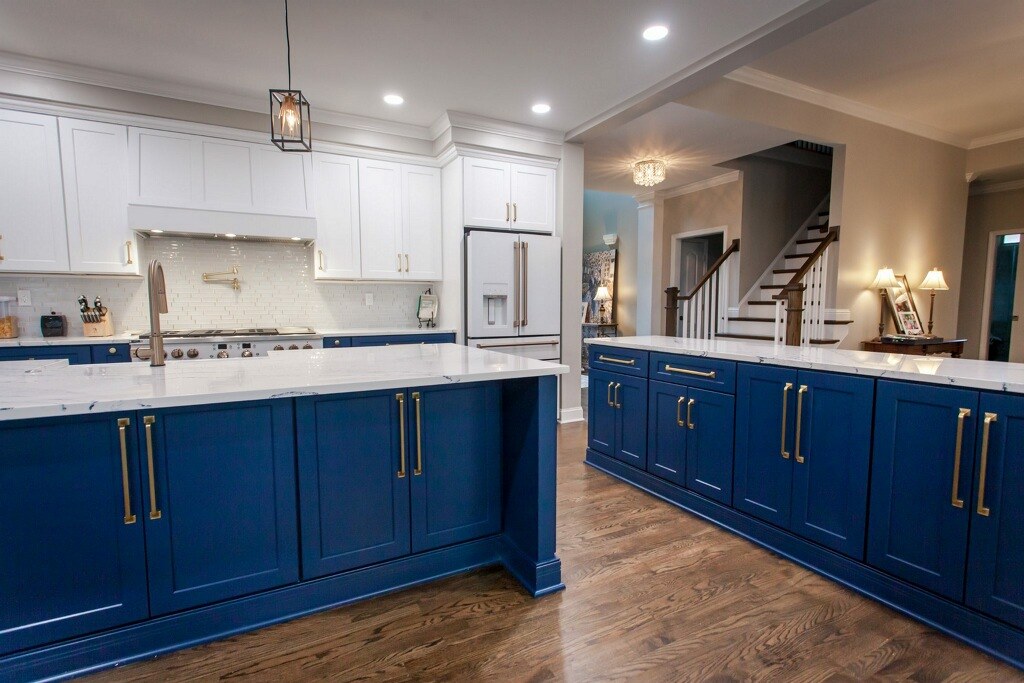
Painted cabinets aren't painted with wall paint. We spray catalyzed lacquer with proper flash times, on doors we've taken off, flat on horses, in a controlled environment — then we re-hang them and adjust every hinge. From Buckhead kitchens to Alpharetta and Milton built-ins, our cabinet painting and refinishing crew handles full-kitchen makeovers, single islands and commercial casework with the same finish schedule.
Custom cabinet refinishing in Atlanta homes
Custom refinishing is for cabinetry worth keeping: solid boxes, good doors, a finish that's tired or the wrong color. We match the sheen and color to the room — flat-matte islands, satin perimeters, high-gloss vanities — and we can spec a color that isn't on any fan deck if that's what the design calls for.
Every refinish starts with an honest read on the substrate. Thermofoil, laminate, raw oak and previously-painted maple each get a different primer and a different schedule. We tell you up front which cabinets refinish beautifully and which ones are better off replaced.
Cabinet painting — doors off, sprayed flat
Doors come off. Hinges come off. Doors are labeled, sprayed flat, and cured before they're re-hung. Spray-in-place on doors is a shortcut that produces the drips, orange peel and dust nibs you can see across the room. We don't do it.
Boxes, face frames and trim are sprayed in place under full containment — masking, plastic, air movers — so a lived-in kitchen stays livable while the work runs.
Stained-to-painted conversion
The most common cabinet job we run is converting stained oak or maple cabinets to a painted, sprayed finish. Wood is degreased, scuff-sanded, and grain-filled where needed. Then it's primer, sand, spray, sand, spray — a real cabinet-finish schedule.
Converting stained cabinets to paint creates very fine dust. On a recent cabinet conversion we masked off the entire kitchen and ran air movers and fans to contain it while we worked. That's what containment on a lived-in home looks like.
Stain-grade cabinet work
When cabinets are staying wood, we bring the same discipline — stain applied consistently, sealed with a lacquer or oil topcoat matched to the wood, sheens dialed in per room. We do this for kitchen islands, built-ins, mudroom lockers and vanities.
Where we work
We paint and refinish cabinets in Atlanta, Buckhead, Brookhaven, Sandy Springs, Alpharetta, Johns Creek, Milton, Roswell, Cumming, Marietta, Woodstock, Duluth, Suwanee and Kennesaw. Older intown kitchens often mean stained oak or maple conversions; newer suburban builds lean toward painted perimeter cabinets with a contrasting island. Both are daily work for our crew.
What's included
- Custom cabinet refinishing — color and sheen matched to the room
- Cabinet painting with sprayed catalyzed lacquer, not wall paint
- Stained-to-painted conversions with full grain fill where needed
- Doors removed, sprayed flat, cured, then re-hung and adjusted
- Full containment — air movers, masking — for lived-in homes
- Stain-grade work for islands, built-ins, mudrooms and vanities
- Residential and commercial casework
From the field — Cabinet conversion
Converting stained cabinets to paint creates very fine dust. We masked off the entire kitchen area and ran air movers and fans to contain it — the family kept living in the house while we worked.